Training When You’re Ill: Should You Train or Rest?
05/10/2026
Starting autumn with a cold? Here’s how to know when to train, when to modify your workout and when to take a proper rest day.
A few weeks ago, one of our members, Laurence, mentioned that he had been feeling under the weather for almost a month. His running had been terrible, and he simply didn’t have his usual energy.
But interestingly, he was still able to complete his strength training sessions and continue making progress.
That conversation got me thinking: when you’re ill, should you train or should you rest?
The answer isn’t always as simple as “never train when you’re sick”.
That conversation got me thinking: when you’re ill, should you train or should you rest?
The answer isn’t always as simple as “never train when you’re sick”.
When is it OK to train?
If you have mild symptoms such as a runny or blocked nose, sneezing or a minor sore throat, and you otherwise feel well, light to moderate exercise may be OK.
Research into exercise and immunity suggests that regular, moderate physical activity is associated with better immune function and a lower risk of some respiratory infections compared with being completely inactive.
Research into exercise and immunity suggests that regular, moderate physical activity is associated with better immune function and a lower risk of some respiratory infections compared with being completely inactive.
That doesn't mean exercise is a cure for a cold — or that you should force yourself through a workout when you feel awful.
It means that if you have a mild cold and still feel reasonably well, gentle movement can be a sensible option.
It means that if you have a mild cold and still feel reasonably well, gentle movement can be a sensible option.
Your normal workout might not be the right workout today.
Instead of trying to hit a personal best, reduce the intensity, shorten the session or choose something less demanding. A controlled strength session might feel completely manageable while trying to run hard feels terrible.
This is exactly what Laurence experienced.
Training doesn’t have to be all or nothing.
Why not just push through?
Because more exercise isn't always better.
Long or very intense training sessions place additional stress on the body. Research suggests that regular moderate exercise can support immune health, while prolonged or very strenuous exercise can temporarily alter immune function — particularly when combined with things like poor sleep, stress, inadequate nutrition and heavy training loads.
So if your body is already fighting an infection, this probably isn't the time to prove how tough you are.
You might reduce the weight, take longer rest periods, swap running for walking or simply do less than you normally would.
And sometimes, as Laurence found, you may discover that one type of training feels fine while another doesn't.
When should you NOT train?
This is where the line becomes much clearer.
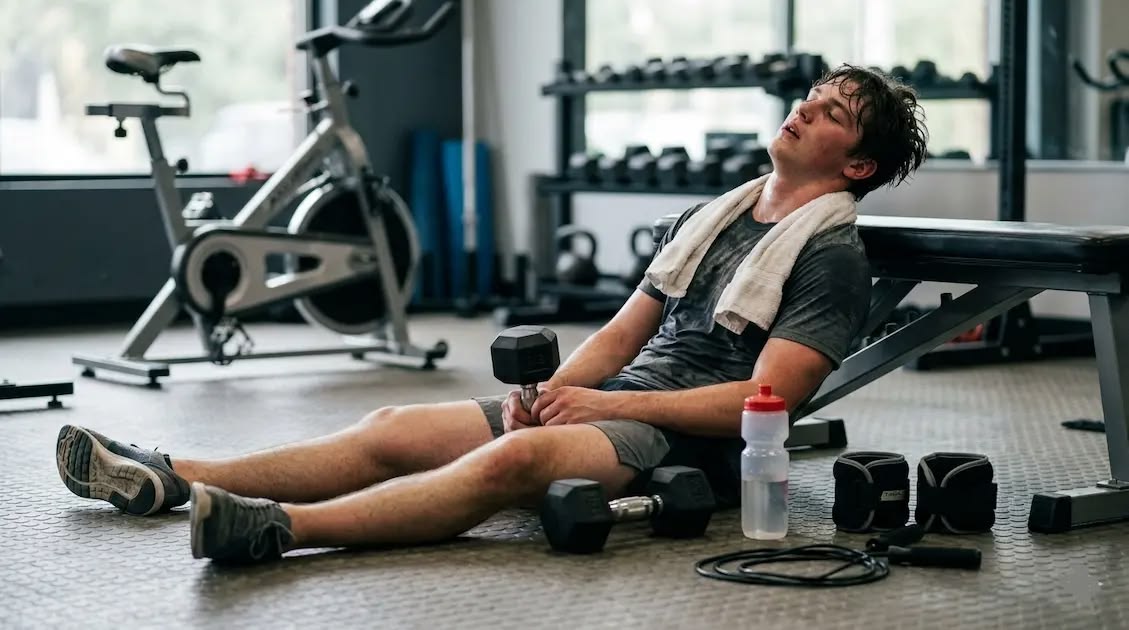
If you have a fever, significant fatigue, widespread muscle aches, chest congestion, a hacking cough, dizziness, shortness of breath, chest pain or you simply feel really unwell, training is not the time to “push through”.
The International Olympic Committee's guidance on respiratory infections recommends stopping exercise if symptoms such as excessive fatigue, breathlessness, chest pain, dizziness, palpitations or feeling significantly unwell appear during exercise.
Sometimes the strongest decision you can make is to rest.
And remember: if you're clearly infectious, staying away from the gym isn't just about your own recovery. It's about protecting everyone else too.
And remember: if you're clearly infectious, staying away from the gym isn't just about your own recovery. It's about protecting everyone else too.
What about losing fitness?
This is often what people worry about most.
You miss one session, then another, and suddenly you feel like you've lost all your progress.
You miss one session, then another, and suddenly you feel like you've lost all your progress.
But taking a few days off when you're genuinely ill isn't going to undo months of training.
When you are ready to return, build back gradually rather than trying to make up for everything you missed. The goal is to get back to normal training without turning a short illness into a longer setback.
So, should you train when you're ill?
Sometimes yes. Sometimes absolutely not.
The important thing is learning to adjust rather than automatically stop or automatically push through.
At Fitness Yard, we don't expect every workout to look the same. Your training should fit your health, your energy, your lifestyle and what your body needs that day.
So this autumn, don't think you have to choose between “100% training” and “doing nothing”.
So this autumn, don't think you have to choose between “100% training” and “doing nothing”.
Learn to listen to your body, modify your training when needed, and know when rest is the right choice.
And let's all help each other this autumn
We can't guarantee that nobody will catch a cold or flu — but we can all do our bit to reduce the spread.
So please use the hand sanitiser at reception before and after your session, and let's wipe down the equipment after we use it.
Good hand hygiene and cleaning frequently touched surfaces are recommended ways to help reduce the spread of respiratory illnesses.
We can't guarantee that nobody will catch a cold or flu — but we can all do our bit to reduce the spread.
So please use the hand sanitiser at reception before and after your session, and let's wipe down the equipment after we use it.
Good hand hygiene and cleaning frequently touched surfaces are recommended ways to help reduce the spread of respiratory illnesses.
Let's start this autumn strong — not just by training, but by looking after ourselves and each other. 💪🍂
If you're unsure whether you should train while you're ill, speak to one of our coaches or a healthcare professional before exercising.
References
- Pedersen et al. — Physical exercise, immune response, and susceptibility to infections — Allergy.
- Campbell & Turner — Can exercise affect immune function to increase susceptibility to infection? — Exercise Immunology Review.
- International Olympic Committee — Consensus statement on acute respiratory illness in athletes. British Journal of Sports Medicine.
- CDC — Hygiene and Respiratory Viruses Prevention.